Unmanned Aircraft Systems
Home > Aeronautics > Unmanned Aircraft Systems


Aeronautics
Unmanned Aircraft Systems
Unmanned Aircraft Systems (UAS/drones) is a form of technology that is revolutionizing the fields of aviation and transportation.
- Since NJDOT established its UAS Program in 2016, we have trained over 30 pilots to operate UAS on behalf of NJDOT.
- All 30 pilots are certified by the Federal Aviation Administration (FAA) under 14 CFR Part 107.
- The purpose of the program is to increase safety, save time and money, and increase the efficiency of the road system.
- The UAS Program serves a variety of units and use cases within NJDOT.
How We Use Drones
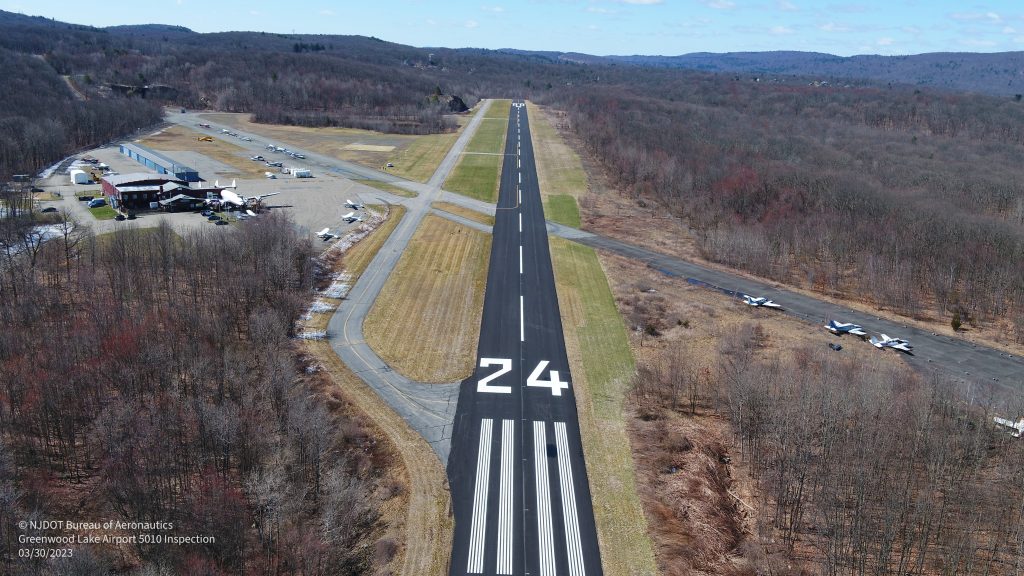
5010 inspection UAS flight at Greenwood Lake Airport (4N1) in West Milford
FAA 5010 Airport Inspections
The NJDOT Bureau of Aeronautics (BoA) performs the 5010 inspections at the state’s 40 public use airports on behalf of the FAA.
- The inspection is performed from the ground by an FAA trained and certified inspector.
- NJDOT Aeronautics uses UAS to capture photos and videos to supplement these 5010 inspections and document the status of each airport.
Emergency Response
The NJDOT Office of Emergency Management (OEM) uses UAS in a variety of ways to respond to emergency situations, on an as-needed basis.
- The inspection is performed from the ground by an FAA trained and certified inspector.
- The UAS capture photos and videos to supplement the 5010 inspections and document the status of each airport.

In July 2023, UAS were deployed to capture aerial photos and thermal images to assist in cleanup and mitigation efforts after a landslide completely blocked NJ-46 in Knowlton Township.

UAS inspection of a NJ-29 exit ramp in Trenton
Bridge Inspections
NJDOT’s Structural Evaluation unit is responsible for bridge inspections throughout the state.
- Many bridges in New Jersey are positioned over water or in other hard-to-reach places.
- Snooper trucks can be used to inspect these bridges, but they are expensive and can require a lane of traffic to be temporarily closed when they are in-use.
- UAS can allow bridge inspectors to perform their duties at a lower cost and without obstructing traffic.
High-Mast Light-Pole Inspections
In addition to inspecting bridges, NJDOT’s Structural Evaluation unit inspects roadside high-mast light-poles throughout the state.
- Bucket trucks can be used for the inspection of these light-poles, but they are expensive and have logistical limitations.
- UAS allows inspectors to complete a 360-degree inspection of a high-mast light-pole in less time and at a lower cost, decreasing the need for the use of bucket trucks.
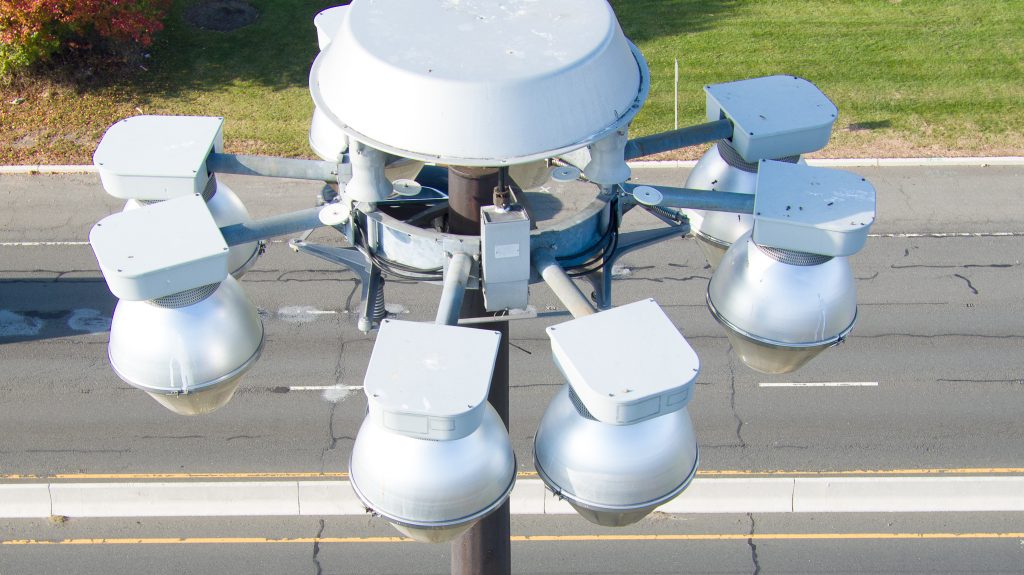
High Mast Light Poles (HMLP) drone inspection

UAS inspection of a pollinator habitat on NJ-35
Wildlife Surveys
NJDOT performs a variety of wildlife surveys on and near pieces of transportation infrastructure.
- The Environmental Resources unit utilizes UAS to survey bridges that serve as habitat for bats.
- The Landscape Architecture unit has planted pollinator habitat areas along interchanges and highways, and utilizes UAS to survey the growth and development of these habitat areas.
Rock Slope Inspections
New Jersey has a number of roadside rock slopes throughout the northern part of the state.
- Without mitigation, these rock slopes can lead to rockfalls that obstruct roadways and create hazards for motorists.
- NJDOT’s Engineering Geology unit uses UAS to inspect and document these rock slopes in order to plan mitigation efforts.
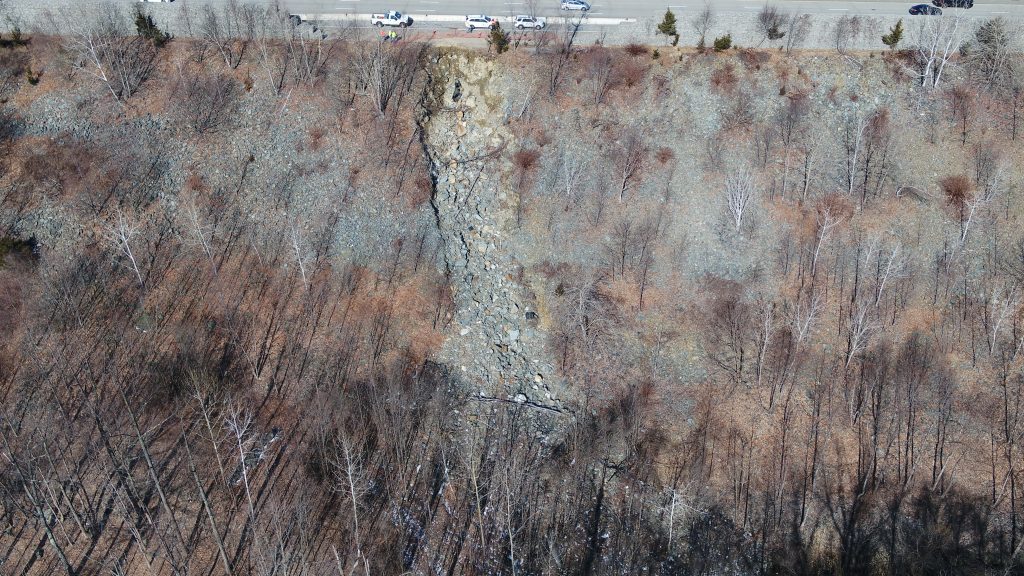
Rockfall on I-287
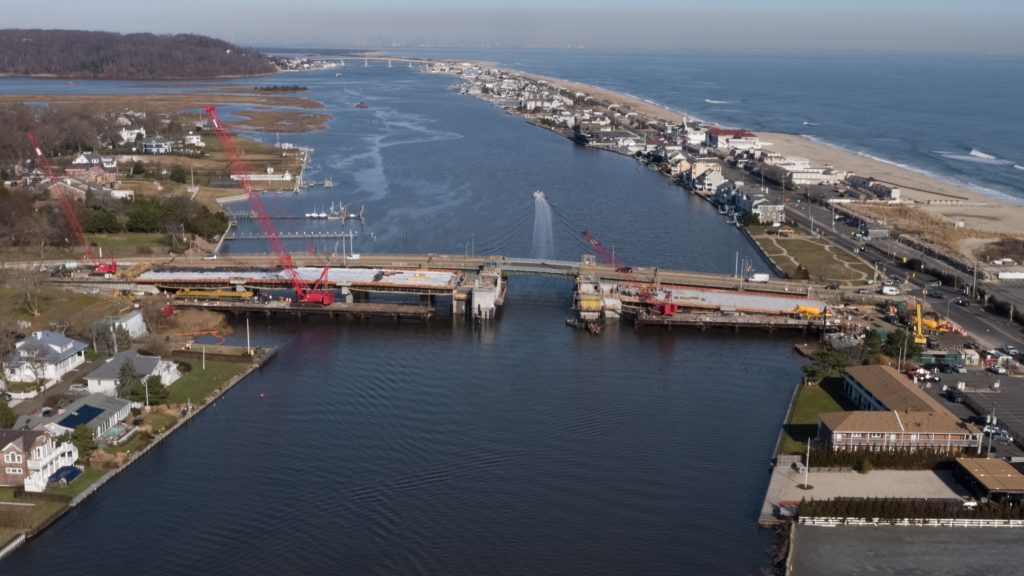
Bridge construction in Sea Bright
Construction Project Monitoring
A variety of units at NJDOT utilize drones to monitor and document the status of construction projects.
- UAS give NJDOT personnel the opportunity to capture aerial images and videos, showing both overviews and detailed images of the entire project site.
Traffic Monitoring
UAS give NJDOT the capability to monitor large stretches of New Jersey’s roads and highways.
- NJDOT personnel can use UAS imagery to monitor congestion that may be caused by lane closures due to traffic incidents or roadway construction.

In July 2019, UAS documented construction activities and traffic conditions before, during, and after an extensive improvement project on NJ-495 in North Bergen.
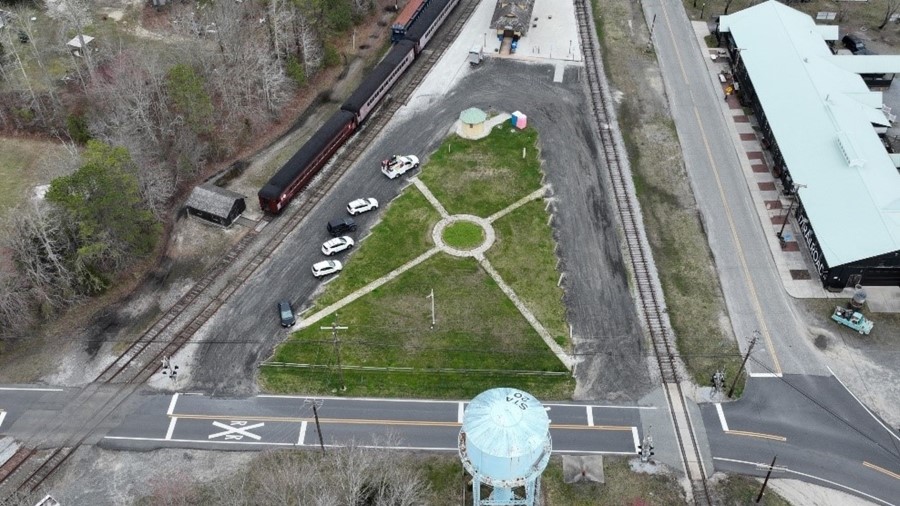
Inspection of a rail line in Woodbine
Railway Inspections
NJDOT’s Fixed Guideway unit performs inspections of railways throughout the state.
- UAS allows NJDOT personnel to inspect long stretches of rail line in a relatively short amount of time, and safely capture overhead photos to document the inspection.
Communications/Training Content
UAS give NJDOT personnel the opportunity to capture photos and videos from unique angles and altitudes.
- This can be incredibly useful for crafting communications content to keep the public informed on NJDOT operations, as well as crafting training materials to make NJDOT personnel better-prepared to carry out their duties.

NJDOT’s Take Your Child to Work Day at NJDOT headquarters in Ewing
Types of Operators
Commercial Operators
A person or company utilizing UAS technology for compensation or business purposes.
Public Operators
A federal, state, or local government entity that uses UAS/drone technology to carry out their functions.
Recreational Operators
A person who flies an UAS solely for hobby or recreational purposes.
Training Program
NJDOT Aeronautics has trained over 30 NJDOT staff across a variety of units to safely and efficiently operate UAS to enhance their job duties. All NJDOT remote pilots are certified by the FAA under 14 CFR Part 107.
Phase 1: Introductory
Trainees receive instruction about the rules, regulations, and concepts addressed in the FAA exam and their first hands-on experience flying drones.
Phase 2: Practical / Operational
Trainees are instructed on NJDOT policies and procedures and given hands-on flying experience to develop practical skills to safely fly without the supervision of an instructor.
Phase 3: Mission Specific
Trainees’ knowledge and skills are tested through a ‘competency check,’ where they plan and execute a job-specific mission under the observation of an instructor.
News and Information
Remote Identification of Drones
The FAA deadline for the rule on remote ID is March 16, 2024.
There are three ways that drone pilots can meet the requirements of the rule on remote ID. More information can be found on FAA’s website.
Operate a Standard Remote ID Drone that Broadcasts Identification and Location Information:
A standard remote ID drone is one that is produced with built-in remote ID broadcast capabilities in accordance with the Remote ID rule’s requirements.
Operate a Drone with a Remote ID Broadcast Module:
A broadcast module is a device that broadcasts identification and location information about the drone and its take-off location in accordance with the Remote ID rule’s requirements. The broadcast module can be added to a drone to retrofit it with Remote ID capabilities. Pilots operating a drone with a Remote ID broadcast module must be able to see their drone at all times during flight.
Operate at FRIAs Sponsored by Community-Based Organizations or Educational Institutions:
FAA-Recognized Identification Areas (FRIAs) are the only locations where UAS (drones and radio-controlled airplanes) may operate without broadcasting Remote ID message elements.
Learn More
Frequently Asked Questions
The FAA has oversight over all airspace in the US. The FAA has developed a mobile app called B4UFLY to help recreational UAS or drone operators understand any restrictions or requirements where they want to fly.
UAS activities may be legislated at the federal, state, and local levels. It is important to check all three before operating a drone.
No; NJ State Park Policy 2.38 prohibits the operation of UAS within all lands and waters administered by the State Park Service unless specifically approved by the Assistant Director, State Park Service in accordance with N.J.A.C. 7:2-1.4(b).
See: P.L. 2017, c.0315 (S3377 1R) (njleg.gov)
The state of New Jersey has no registration requirements; however the FAA requires registration of all drones weighing at least 0.55 lbs (250 g), or used for commercial purposes.
Drones offer unique opportunities in the transportation industry. They can offer an aerial view of a project site or provide access to hard-to-reach places. They increase safety by taking workers out of harm’s way, decrease cost by reducing need for more expensive equipment, save time by completing some projects more quickly, and increase the efficiency by allowing NJDOT personnel to monitor traffic patterns and to complete projects with fewer road and lane closures.
NJDOT requires all of its UAS pilots to undergo a comprehensive training course and receive their Part 107 remote pilot certificate from the FAA. Each NJDOT UAS flight is subject to an approval process prior to the flight day, where NJDOT Aeronautics verifies that the remote pilot in command (RPIC) is following all laws and safety procedures, as well as considering all risk factors and how to mitigate them. Additionally, NJDOT requires all remote pilots to be accompanied by a visual observer, who assists the remote pilot in identifying potential hazards to their drone flight.
NJDOT takes privacy very seriously and is committed to protecting the privacy of the public throughout its UAS operations. For that reason, NJDOT’s UAS remote pilots are trained to take care in ensuring that UAS deliverables do not include recognizable people.
The FAA offers UAS resources and information on their website.